


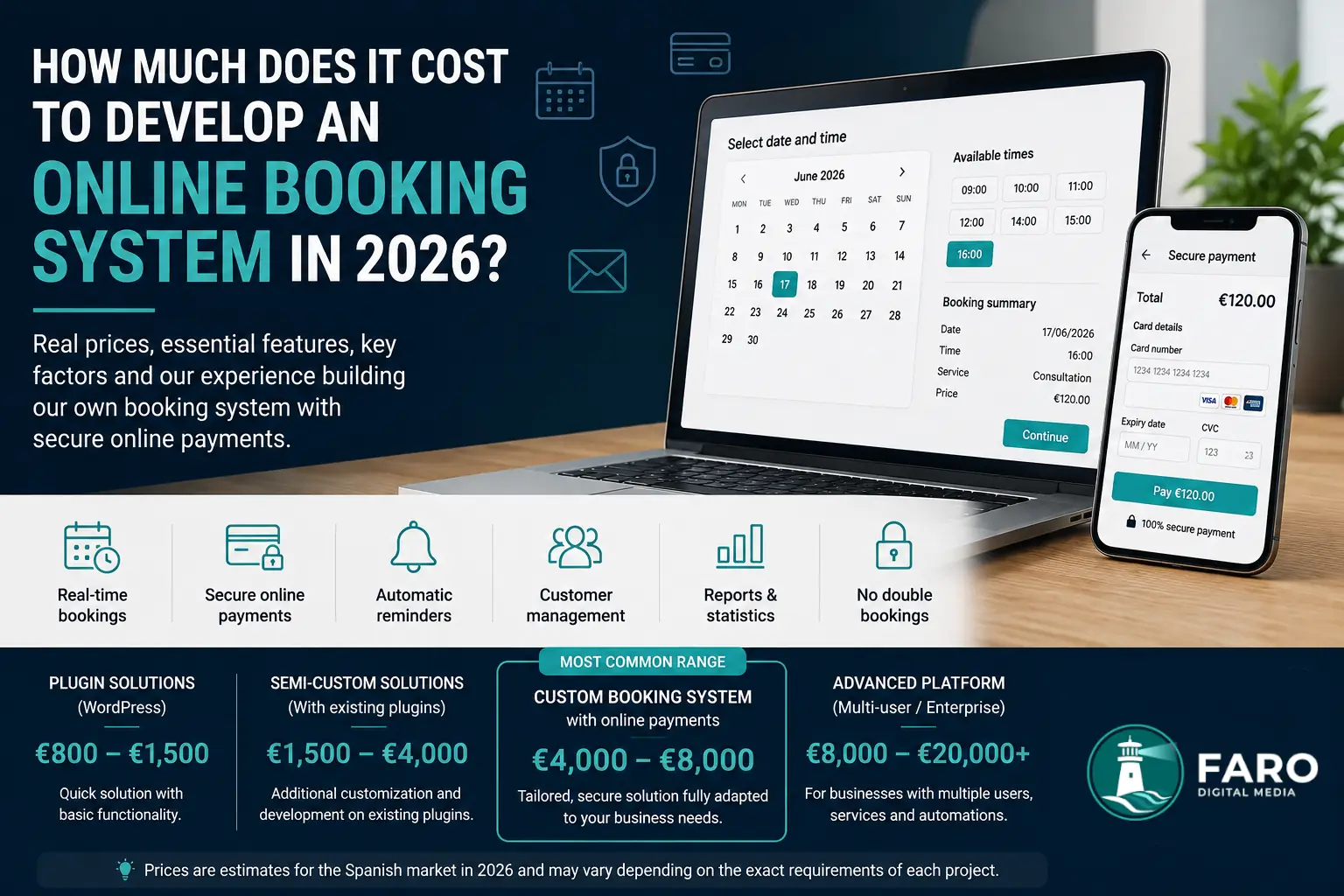
An online booking system can cost from approximately €800 for a simple plugin-based setup to €20,000 or more for a custom platform with multiple users, payments, calendars and business integrations.
For many small businesses, a professional system with a calendar, automated confirmations and card payments will typically cost between €4,000 and €8,000. The final price depends less on visual appearance than on the rules the system must manage.
At Faro Digital Media, we speak from practical experience: we developed and operate our own booking system with payment processing, availability management, confirmations and administrative controls. This allows us to explain not only what a system may cost, but also which features require the most work and which ones create genuine business value.
Typical online booking system prices
| Type of solution | Typical price | Suitable for |
|---|---|---|
| Configured plugin or external tool | €800 – €1,500 | Freelancers and businesses with simple bookings |
| Semi-custom system | €1,500 – €4,000 | Small companies with limited rules |
| Custom system with online payments | €4,000 – €8,000 | Businesses requiring control over the full process |
| Multi-user or multi-location platform | €8,000 – €20,000+ | Clinics, academies, centres and marketplaces |
These figures are indicative. A small system may cost less when its rules are simple, while an apparently basic platform can become more expensive if it must synchronise calendars, split payments, manage resources or connect to external software.
What does a basic booking system include?
A basic solution normally allows a customer to:
- Select a service.
- View available dates and times.
- Enter contact details.
- Receive an email confirmation.
- Cancel or modify the booking through a link.
For the business, it will normally include an administrative calendar, booking records and manual availability controls.
When the process does not require payments, multiple employees, special rules or integrations, an existing tool may be sufficient. Not every business needs custom development.
How much does card payment integration cost?
Payment integration will often add approximately €1,000 to €3,000 to a project, depending on how the payment process works.
Charging one fixed amount is very different from managing:
- Deposits and final payments.
- Different prices for each service.
- Taxes and invoices.
- Coupons or discounts.
- Full or partial refunds.
- Failed payments.
- Pending bookings while a transaction is confirmed.
- Secure notifications sent by the payment provider.
Card details should not normally be stored directly in the website database. The usual approach is to use an authorised payment provider that processes sensitive information and informs the booking system when the payment has been completed successfully.
Features that increase development costs
1. Real-time availability
Displaying available times may look simple, but the system must consider service duration, working hours, breaks, public holidays, leave, existing bookings and preparation time between appointments.
2. Preventing double bookings
Two customers may try to reserve the same time almost simultaneously. The system must validate availability again when confirming the booking and may need to hold the slot temporarily during payment.
3. Multiple employees, rooms or resources
A booking may depend on the combined availability of a professional, room, vehicle or item of equipment. Each additional resource creates more rules and possible combinations.
4. Customer accounts
A private account can allow customers to review bookings, download invoices, make a later payment, save details and manage cancellations. It also requires authentication, password recovery, data protection and permission controls.
5. Confirmations and reminders
Automated emails are usually included, but SMS or WhatsApp reminders may require external services and per-message charges.
6. Calendar synchronisation
Integration with Google Calendar, Microsoft Outlook or other calendars reduces manual work, but must handle changes, cancellations, time zones and possible conflicts.
7. A custom administration panel
The business may need filters, reports, customer management, data exports, refunds, blocked time periods and different access levels for staff.
8. Business integrations
Connecting the system to a CRM, accounting platform, ERP, video meeting service or email marketing tool can create substantial value, but each integration requires additional development and testing.
Booking plugin or custom development?
| Option | Advantages | Limitations |
|---|---|---|
| Plugin | Lower initial cost and faster launch | Provider dependency and less flexibility |
| External service | Technical maintenance is included | Recurring fees, external branding and fragmented data |
| Custom development | Full control, integration and business-specific rules | Higher initial investment and ongoing maintenance |
A plugin is usually the best choice when the business can adapt to the tool. Custom development makes sense when the tool must adapt to the business.
When is a custom solution worthwhile?
A custom system is often justified when:
- Existing tools force the company to change its commercial process.
- There are several types of users, employees, locations or resources.
- Prices depend on specific business rules.
- The booking must connect to payments, invoicing or a CRM.
- The company needs full control over data and customer experience.
- The combined subscriptions for several tools begin to exceed the cost of owning a solution.
- The booking process is an essential part of the service the company sells.
What we learned by developing our own system
While building our booking and payment system, we found that the visible form is only a small part of the work. The most important processes take place behind the scenes:
- Confirming that the time is still available.
- Correctly linking the booking to its payment.
- Preventing duplicates when a user refreshes a page.
- Managing incomplete or failed payments.
- Sending confirmations only when appropriate.
- Allowing an administrator to correct problems.
- Keeping a clear record of each operation.
We also learned that the business rules should be designed before the interface. An attractive calendar cannot repair a poorly defined process.
Maintenance costs
After launch, a booking system requires maintenance. As a guide, this may cost between €100 and €500 per month, depending on complexity and the required level of support.
Maintenance may include:
- Security updates.
- Backups.
- Error monitoring.
- Testing after payment-provider changes.
- Adaptation to legal or tax changes.
- Minor improvements and staff support.
Payment-provider fees, transactional email, SMS messages and external APIs should also be considered.
Example project budget
A system for a small business might include:
- A catalogue of three services.
- An availability calendar.
- Date and time selection.
- Full payment or a card deposit.
- Confirmation emails.
- An administration panel for viewing and modifying bookings.
- Mobile-friendly design.
- Privacy and security measures.
A project of this type would normally cost between €4,000 and €8,000. If multiple locations, employees, memberships, advanced invoicing, mobile applications or complex integrations are added, the budget may exceed €10,000.
Frequently asked questions
Can I start with a plugin and develop a custom solution later?
Yes. A plugin can be a sensible first stage for validating demand. Check that the data can be exported and avoid making the entire operation dependent on a tool that will be difficult to replace.
Are online payments essential?
No. Some businesses only need confirmed appointments. However, deposits can reduce no-shows and protect reserved time.
How long does development take?
A simple integration may be completed in a few weeks. A custom system with payments and an administration panel will typically require approximately six to twelve weeks, while a complex platform may take several months.
Can it be integrated into an existing website?
In many cases, yes. Feasibility depends on the current technology, code quality and the way users, sessions and payments are managed.
Who owns the system?
This should be defined in the contract. For custom development, clarify ownership of the code, licences for third-party components, hosting, data and access to service accounts.
Request an assessment of your booking system
Before preparing a quotation, the services, availability rules, payments, users and integrations must be defined. Faro Digital Media can analyse the process and recommend an existing tool, a semi-custom solution or custom web development.