


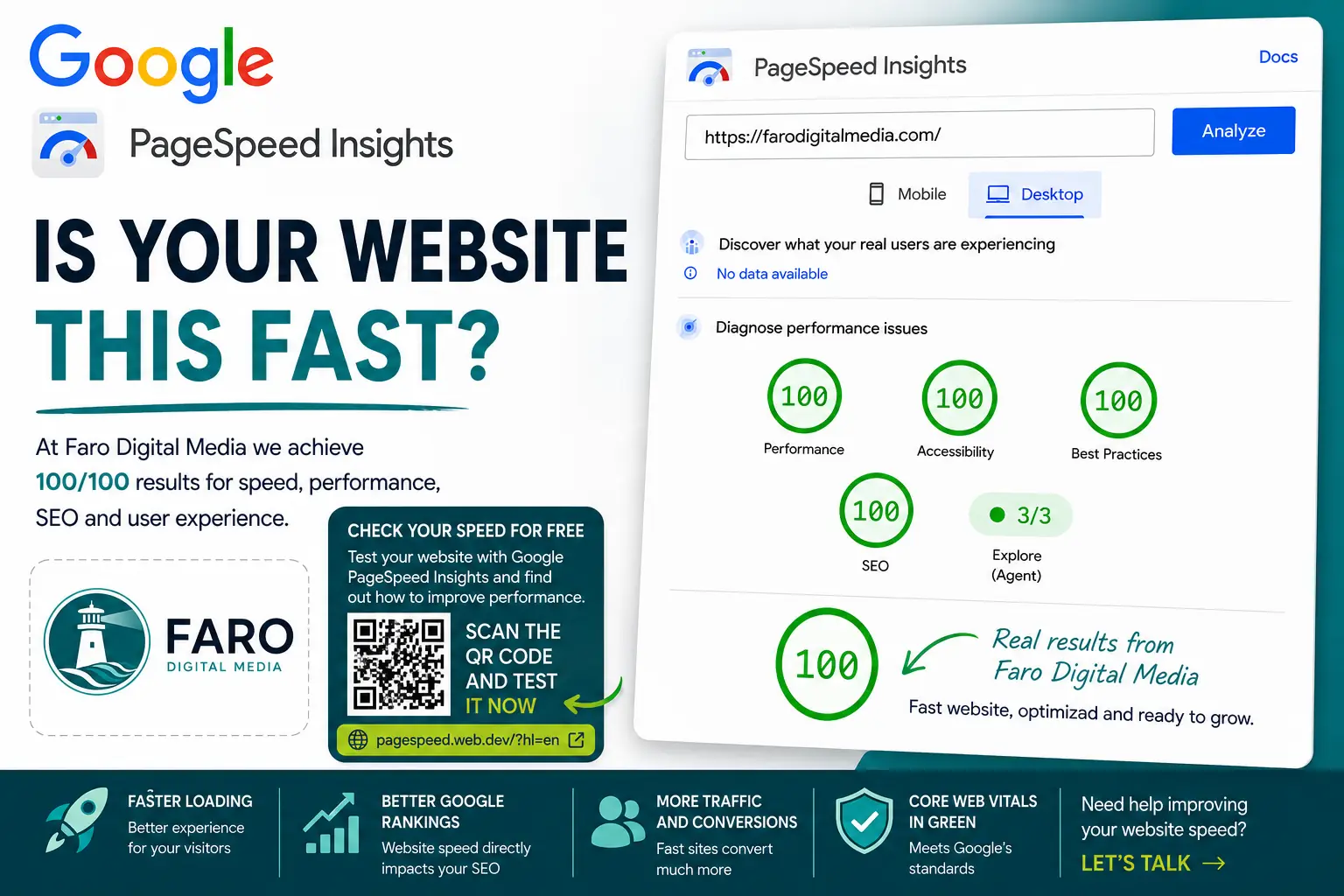
Website page speed is not merely a technical detail for developers. It directly affects user experience, visibility in Google and a website's ability to turn visits into enquiries or sales.
When a page takes too long to display its content, many people leave before understanding what the business offers. A fast website, on the other hand, feels more professional, makes navigation easier and helps users reach the information, form or product they need sooner.
What is website page speed?
Page speed is the time a web page needs to display its content and become ready to respond to the user. It is not measured only by the moment the first element appears. It also matters when the main content becomes visible, how quickly the page responds to interactions and whether elements move while the page finishes loading.
A website can therefore appear fast at first and still provide a poor experience if buttons respond slowly, content shifts position or the main image takes too long to appear.
Why a fast website improves user experience
Users expect an immediate response. Performance problems become even more noticeable when someone visits on a mobile phone, uses an unstable connection or has a less powerful device.
A fast page helps visitors to:
- Understand the business offer quickly.
- Move between services without interruptions.
- Read content without unexpected layout changes.
- Complete forms or purchases with less friction.
- Feel more confident in the quality and professionalism of the business.
Speed should not be assessed in isolation. It is part of web design, usability and conversion strategy.
How page speed affects SEO
Google uses signals related to page experience and performance to understand how a website works for real users. A fast page does not guarantee a first-place ranking because content quality, relevance, authority and search intent remain essential. However, poor performance can reduce the overall quality of the experience and make a website less competitive.
Speed also affects SEO indirectly. When users leave before reading the content, view fewer pages or fail to complete an action, the website wastes some of the traffic it has already worked to attract.
An effective SEO strategy should combine useful content, clear structure, crawlability, technical optimisation and a fast experience across mobile and desktop devices.
What are Core Web Vitals?
Core Web Vitals are metrics focused on specific parts of the user experience. The three principal metrics are:
- Largest Contentful Paint (LCP): measures how long it takes for the main visible element, such as a hero image, video or important block of text, to appear.
- Interaction to Next Paint (INP): evaluates how quickly the page responds when a user clicks, taps a button or interacts with an element.
- Cumulative Layout Shift (CLS): measures visual stability and detects content that unexpectedly changes position while loading.
These metrics help identify issues that a general performance score may not fully explain. A page may display some content early but still deliver a poor experience if its main element is late, interactions are blocked or the layout moves.
How to test a website's page speed
One of the best-known tools is Google PageSpeed Insights. Enter the address of a page to receive separate reports for mobile and desktop.
Test your website speed for free
Enter your page address in Google's official tool to check mobile and desktop performance, review Core Web Vitals and discover which elements need improvement.
PageSpeed Insights can display two kinds of information:
- Field data: when available, this reflects real user experiences collected over a period of time.
- Lab data: tests carried out under controlled conditions that help diagnose opportunities for improvement.
Do not focus only on the large numerical score. The report is most useful when it is used to identify specific problems, understand their real impact and decide which improvements should be prioritised.
Common problems that make websites slow
Images that are too large
Images that have not been resized or compressed can add several unnecessary megabytes. They should be delivered at appropriate dimensions, in modern formats and lazy-loaded when they do not appear near the top of the page.
Heavy hero videos
A background video can create a strong visual impact, but it should be compressed, adapted for mobile and supported by a fallback image. It should not prevent the main content from becoming visible promptly.
Too much JavaScript
Tracking scripts, animations, widgets, chats, maps and plugins compete for browser resources. Code that is not essential should be deferred, reduced or removed.
Poorly configured CSS and fonts
Large stylesheets and external fonts can delay the first render. Critical CSS, efficient font loading and the removal of unused rules can greatly improve perceived speed.
Slow hosting and missing caching
If the server takes too long to generate a response, the browser cannot begin building the page. Caching, compression, a current PHP version, an optimised database and suitable hosting can reduce response time.
Unnecessary plugins and dependencies
In systems such as WordPress, every plugin can add database queries, styles, scripts or external requests. Using more plugins than necessary increases the risk of performance, compatibility and security problems.
Mobile and desktop results are different
It is common to receive a high desktop score and a significantly lower mobile score. Mobile tests generally simulate more limited devices and connections, revealing problems that may not be noticeable on a powerful computer with a fast network.
The mobile version should be reviewed independently. Reducing image and video sizes, simplifying animations, prioritising above-the-fold content and limiting third-party scripts can make a substantial difference.
A score of 100 should not be the only goal
A perfect score can be a useful reference, but it does not always represent the best commercial or design decision. Necessary functions such as payment gateways, maps, booking tools and analytics systems can have a performance cost.
The goal should be balance: a fast, stable and usable website that keeps the functions required to produce results. Improvements with the greatest real impact should be prioritised rather than removing useful features simply to gain a few points.
How to improve page speed without damaging the website
Optimisation should be carried out in a controlled way. Applying large changes without testing can break the design, forms, menus, checkout functions or compatibility between devices.
A professional process normally includes:
- Measuring the most important pages before making changes.
- Identifying the elements affecting LCP, INP and CLS.
- Reviewing hosting, code, images, video, fonts and scripts.
- Applying improvements in stages.
- Testing on mobile, desktop and different browsers.
- Comparing the results before and after optimisation.
- Monitoring the website so future changes do not reduce performance.
Professional website maintenance also matters because a page that is fast today can become slower after new images, plugins, campaigns, tracking tags or content changes are added.
Speed should be part of web design from the beginning
It is possible to optimise a website after it has been completed, but it is more effective to consider performance during design and development. Technology choices, code structure, media handling and the number of dependencies all influence speed from the first day.
At Faro Digital Media, we design and develop fast, responsive websites prepared to deliver a clear experience on mobile and desktop. Our approach combines design, development, technical SEO and performance optimisation so that a visually impressive website does not lose customers because it loads slowly.
Test your website speed now
What score does your website achieve?
Test the homepage first, followed by pages that receive traffic, present services, contain forms or form part of the purchasing journey.
If the report identifies performance problems or you are unsure which recommendations to apply, Faro Digital Media can review your website, identify the real causes and explain what is slowing it down and how to fix it without removing the functions your business needs.
Test your website first. If the result is not where you want it to be, request a professional review and we will help you turn the report into practical improvements.