


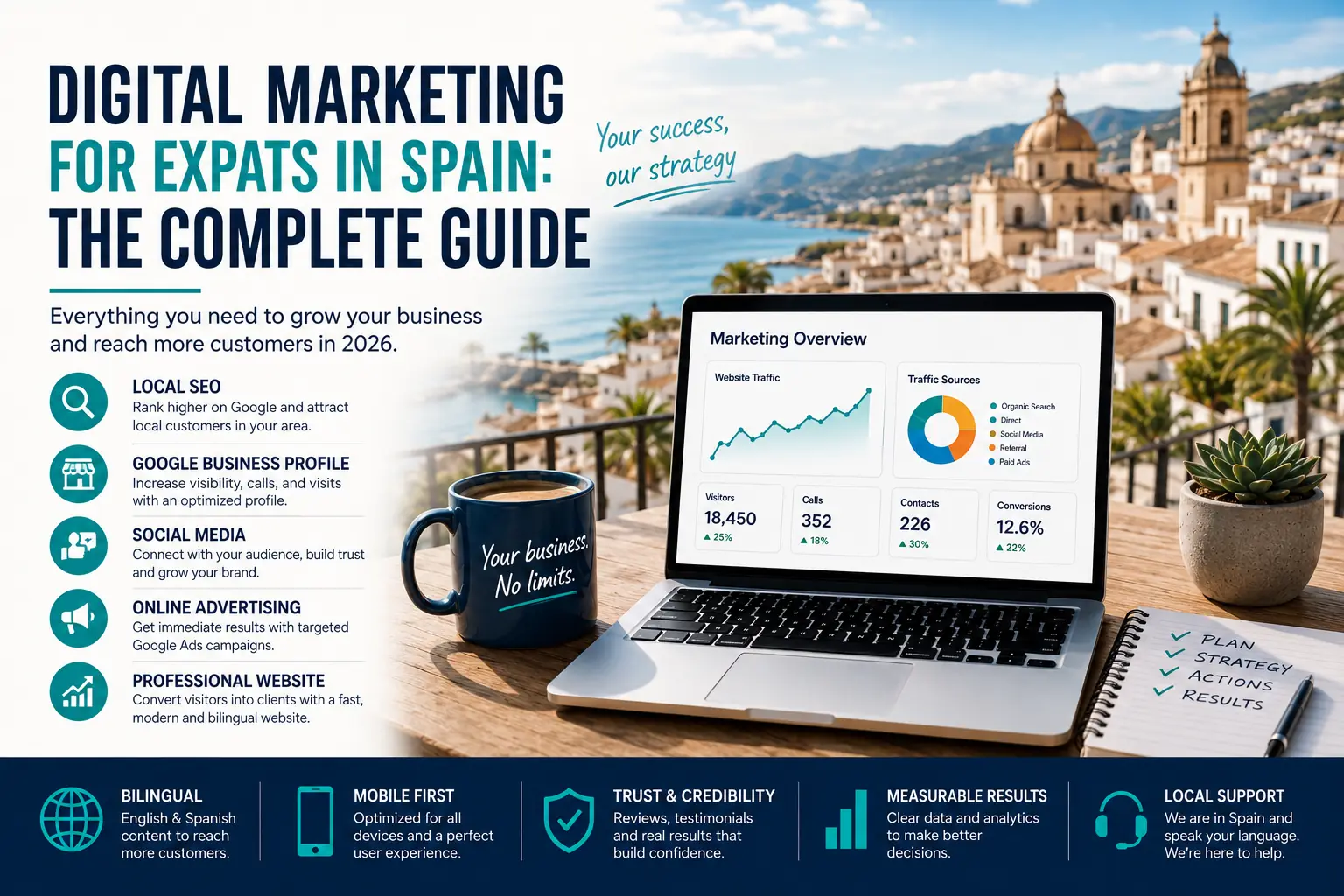
Moving to Spain to start or grow a business is an exciting opportunity, but a strategy that worked in another country will not always produce the same results here. Search habits differ, competition changes and Spanish and international customers may look for different trust signals.
Digital marketing for expats in Spain is not simply a matter of translating a website. It means adapting the message, local visibility and acquisition channels to reach both Spanish customers and international residents.
Why digital marketing in Spain requires adaptation
Many international businesses begin with an English website, a few social posts and personal recommendations. That may generate early enquiries, but it rarely creates a predictable flow of customers.
Customers in Spain often value:
- Clear local information.
- Spanish-language content.
- Verifiable reviews.
- Fast responses by telephone or WhatsApp.
- Clearly explained prices and services.
- A fast, professional website.
At the same time, many foreign residents search entirely in English. A business prepared to serve both markets can significantly expand its reach.
1. Define exactly who you want to attract
Before spending money on advertising, identify the type of customer that offers the greatest value to your business. “Everyone” is not a useful target audience.
Spanish customers
They often value proximity, clarity, reviews, experience and natural Spanish communication.
Expats and international residents
They look for providers who can communicate in English and understand how the Spanish market works.
International companies
They usually prioritise professionalism, technical expertise, reliable management and multilingual capability.
Tourists
In hospitality, holiday rentals, activities and health services, Google Maps, reviews and immediate availability can directly influence bookings.
2. Your website should be the centre of the strategy
Social platforms change, algorithms reduce reach and advertising stops when the budget stops. Your website remains the digital asset your company controls.
A professional website lets you control:
- Your brand and message.
- Content and SEO.
- Speed and mobile experience.
- Forms, bookings and payments.
- Conversion tracking.
The website should explain what the company does, who it helps, where it operates and what the visitor should do next.
3. A bilingual website can expand your market
An English-only website limits visibility among Spanish users. A Spanish-only site can miss opportunities among international residents.
A correct bilingual implementation should include:
- Complete content in each language.
- Independent titles and descriptions.
- Consistent URLs.
- Correct hreflang tags.
- Language-appropriate internal links.
- Translated images and calls to action.
Do not rely only on automatic translation. The copy should sound natural and match the search intent of each audience.
4. Local SEO
Local SEO helps a business appear when someone searches for a service in a particular area. Examples include:
- English lawyer Marbella
- dentist Alicante
- web design Madrid
- accountant for expats Valencia
A local strategy combines helpful content, service pages, authority, internal links, website speed, reviews and genuine geographic relevance.
5. Google Business Profile
For local companies, Google Business Profile can be one of the highest-return channels available. It allows a business to appear in Google Maps and display hours, photographs, reviews, services, telephone details and its website.
Keep the following accurate:
- Name, address and telephone number.
- Primary and secondary categories.
- Opening and holiday hours.
- Services and descriptions.
- Real photographs.
- Posts and updates.
See our guide to optimising your Google Business Profile.
6. Reviews and online reputation
Reviews influence trust and buying decisions. Invite only genuine customers to leave feedback and always respond professionally.
Also keep your business information consistent across LinkedIn, professional directories and relevant industry platforms.
7. Social media
Social media should support your strategy rather than replace your website.
It works especially well for visually led businesses such as restaurants, estate agents, fashion, art, design and tourism.
It remains useful for local groups, international communities, events and recommendations.
It is particularly relevant for B2B services, consulting, technology and commercial relationships.
TikTok
It can work well for educational content, demonstrations, tours and short, direct communication.
8. Google Ads
Google Ads can generate immediate visibility, but it cannot repair a slow or unconvincing website. Before investing, make sure landing pages:
- Load quickly.
- Explain the service clearly.
- Demonstrate trust and experience.
- Include an obvious call to action.
- Work correctly on mobile.
Advertising is most effective when it complements organic marketing rather than acting as the only source of customers.
9. AI search
People no longer search only through Google. They also ask tools such as ChatGPT, Gemini, Copilot and Perplexity.
To improve your chances of appearing in recommendations and answers, publish clear, complete and useful information:
- Detailed guides.
- Frequently asked questions.
- Prices and comparisons.
- Practical examples.
- Consistent business information.
10. Email marketing
Email remains one of the highest-return channels because the list belongs to the business. It can support newsletters, reminders, launches, educational content and commercial follow-up.
A small, engaged list is usually more valuable than a large inactive audience.
11. Speed and user experience
Speed affects user experience, SEO and conversions. Oversized images, unnecessary scripts, plugins and poor hosting can damage performance.
Test important pages regularly and read our Google PageSpeed Insights guide.
12. Measurement and analytics
Without measurement, it is difficult to know which activities generate results. Configure Google Search Console and track meaningful conversions such as:
- Submitted forms.
- Telephone calls.
- WhatsApp clicks.
- Bookings.
- Purchases.
Analytics should respect consent choices and applicable privacy requirements.
13. Booking and automation
Service businesses can reduce administration by offering online appointments, deposits, automated confirmations and reminders.
Read our guide to the cost of developing an online booking system.
Marketing channel comparison
| Channel | Cost | Speed | Long-term value |
|---|---|---|---|
| SEO | Medium | Slow | Excellent |
| Google Business Profile | Very low | Fast | Excellent |
| Google Ads | High | Immediate | Stops when spending stops |
| Social media | Low | Variable | Good |
| Email marketing | Low | Fast | Excellent |
Common mistakes
- Relying only on Instagram or Facebook.
- Ignoring Spanish customers.
- Using poor translations.
- Failing to create a Google Business Profile.
- Running a slow website.
- Having no clear calls to action.
- Failing to measure results.
- Paying for ads before improving the website.
A practical staged plan
Stage 1
- Build a professional website.
- Prepare bilingual content.
- Configure Google Business Profile.
- Set up Search Console and analytics.
Stage 2
- Optimise service pages.
- Publish useful content.
- Improve speed.
- Collect genuine reviews.
Stage 3
- Test Google Ads campaigns.
- Begin email marketing.
- Publish consistently on relevant social platforms.
- Build local partnerships.
Frequently asked questions
Do I need a Spanish website?
If you want to attract Spanish customers, usually yes. A bilingual website broadens the market and builds trust.
SEO or Google Ads?
Google Ads provides immediate visibility. SEO builds sustainable traffic. Many businesses use both.
How long does SEO take?
There is no guaranteed timeframe. It depends on competition, authority, content and technical quality.
Is social media enough?
Usually not. Social platforms support the strategy, but the website should remain central.
Will artificial intelligence replace SEO?
No. It changes how businesses are discovered, but still depends on reliable, well-structured information.
Conclusion
Digital marketing for expats in Spain means understanding two markets and building a presence that inspires confidence in both. A bilingual website, local SEO, a complete Google Business Profile, strong reviews and accurate measurement create a solid foundation.
Faro Digital Media helps Spanish and international companies create websites, SEO strategies and digital systems adapted to the Spanish market.